Your Claude. An extension of you.
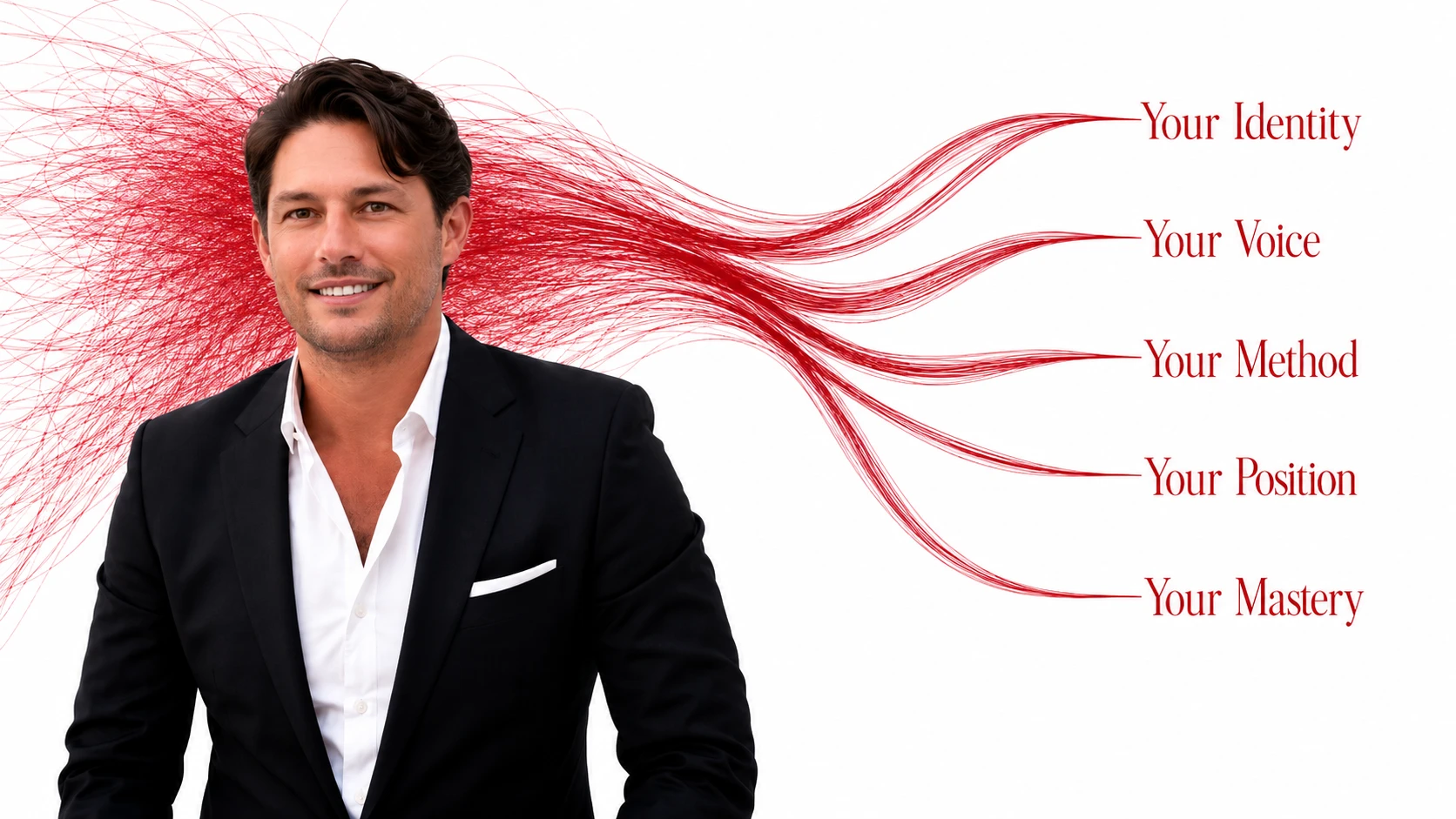
Every other tool makes AI sound like you. We make Claude an extension of you.
Informed by peer-reviewed behavioral science and fifty years of brand communication research. The rigor that built the world's most recognizable brands, encoded into you.
Your voice, your expertise, your positioning, your way of working. Encoded permanently. Present in every conversation.
What AI doesn't know about you.
Claude produces the same output for you as for someone who started last year. It doesn't know the positioning you spent a career developing. It doesn't know what makes your work distinct. It doesn't know your standards, your frameworks, or the voice that makes your work recognizable before anyone sees your name. It skims. It assumes. It outputs generic.
That is what Old School AI was built to solve.
How it works.
A structured questionnaire informed by fifty years of behavioral science and brand communication research. Not “describe your brand voice.” Specific, behavioral questions. They surface how you actually think and work, not the version you'd put in a bio.
Your answers become a living identity profile. Claude reaches it directly through the Old School AI connector. Connect once. Present in every conversation, current every time.
The questionnaire does the translation work. Most professionals have no framework for converting what they know into structured, AI-readable context. Ours is built for exactly that.
Five minutes to connect. Five layers to complete. The Quick Start connects Claude the same day. After that, one chapter a day, 15 to 20 minutes each, until every layer of your professional identity is encoded.
You already know these frameworks.
You've billed for them.
Positioning. Brand identity. Messaging architecture. You don't need these methodologies explained. You've used them. You know what agencies charge to apply them. Old School AI is the only tool in this category actually grounded in them. Every other tool asks you to describe your voice. Ours runs you through the frameworks you'd run a client through, rebuilt for one person instead of a company.
The methodologies behind our questions are the same ones 80% of the Fortune 100 still pay to apply. Among them: Nintendo, which credited the differentiation framework for the Wii; Salesforce and Google, from the adoption playbook author's own roster; and the guarantee tradition's confirmed cases from Casper to Zappos. Rebuilt and grounded in verifiable methodologies, with the same rigor the McKinseys and Boston Consulting Groups of the world apply.
The brand identity work draws on the brand-equity frameworks behind the annual most-valuable-brands rankings. The world's most valuable brands still pay consultancies to apply them. Tested, tried, and true.
We didn't skim summaries. We acquired the primary sources and read them. We can tell you which page each design decision came from. Every specific research claim is checkable. Ours holds.
Pricing
Personal
Your identity profile. Your voice. How you operate.
Free
Always. No credit card required.
·Identity Profile (Your Identity, Your Voice, Your Method)
·Brand Voice skill
·Internal Communications skill
·Copywriting skill
·AI Platform Migration Coach skill
The method, in your hands. You answer, guided by the frameworks built into every question, and your answers never touch an AI system. It's you and the research that built the world's most recognizable brands, applied to you.
Start for free →Personal + Professional
Everything in Personal, plus your professional layer and the full expert skills library.
$99.99
per year
$8.33/month, billed annually
·Everything in Personal
·Professional Profile (Your Position and Your Mastery)
·A full library of expert skills, built from your profile
·Updates as your profile evolves
·Cross-device, always-on
The method, applied with you. We review every answer against the same behavioral-science frameworks and brand research the questions are built on, then give you feedback to sharpen each layer, the review a brand strategist would run, built in, so your identity encodes as precisely as possible.
14-day free trial
Cancel anytime in the trial. Card required to start.
What gets encoded: skills for marketing and communications.
Your identity profile powers all of these. The skills below are part of Personal + Professional. The free tier includes Brand Voice, Internal Communications, Copywriting, and AI Platform Migration Coach. A strong foundation. Personal + Professional adds a full library of expert skills across every category of marketing and communications, and it keeps growing.
Writing & Copy
A sample of the skills included
Social Content
Platform-specific posts for LinkedIn, X, Instagram, TikTok, and Facebook, in your voice, with hook formulas and content strategy built in.
Repurposing Engine
Takes one piece of long-form content and systematically extracts every format from it (posts, threads, emails, scripts), all in your voice.
Human First
Removes AI tells from existing content (the filler phrases, hollow transitions, and giveaway cadence) so it reads like a person wrote it.
Marketing & Growth
A sample of the skills included
Content Strategy
Editorial plans, topic clusters, and content calendars aligned to your audience, goals, and voice, not generic templates.
Word of Mouth Engine
Applies peer-reviewed social science research on why things spread to make your ideas, content, and products shareable by design.
Customer Intelligence
Synthesizes customer interviews, reviews, and feedback into actionable intelligence: voice of customer patterns and the messaging that lands.
Communication & Documents
A sample of the skills included
Media Pitch Writer
Writes one-to-one pitches to specific journalists (news peg, story angle, why you), structured for how media actually decides what to cover.
Messaging Hierarchy
Builds the architecture of how you talk about yourself across every context: tagline, one-liner, elevator pitch, and full narrative.
Expert Methodologies
A sample of the skills included
Memorable Messaging
A six-variable framework developed from decades of communications research that identifies the traits of ideas that get remembered, applied to your messaging before it goes out.
Market Positioning
A positioning methodology built on five core components, used by companies from early-stage startups to publicly traded brands. Defines who you're for, what makes you different, and which market category you can credibly own.
Narrative Messaging
The narrative structure behind some of the most recognized brand messaging in the world. Applied to every piece of messaging you produce.
Authority & Platform
A sample of the skills included
LinkedIn Authority
A systematic thought leadership presence on LinkedIn: content strategy, post structure, engagement system, and consistency framework.
Podcast Authority
Authority through podcasting, as a guest or host, with pitch strategy, talking points, and show positioning.
AI Visibility
A sample of the skills included
GEO: AI Search Visibility
Optimizes content to appear in AI-generated answers from Perplexity, ChatGPT, and Gemini. Citations, not just clicks.
Conversion, Analytics & Revenue
A sample of the skills included
Page Conversion
Optimizes any marketing page: message clarity, proof placement, CTA strength, and friction removal.
A/B Testing
Structures experiments correctly (hypothesis, control, variant, sample size, and statistical significance) so results are real, not noise.
FAQ
Questions worth asking.
What is Old School AI?
Old School AI is an identity system for Claude. It encodes who you actually are into your Claude permanently: your background, values, communication style, how you operate, and professional expertise. Every output Claude produces for you runs through that context. It stops guessing and starts knowing.
How does the process actually work?
Three steps.
First, the questionnaire. It opens with the Quick Start: a handful of essential questions, about five minutes, enough for Claude to become an extension of you the same day. Then five chapters, one a day, about 15 to 20 minutes each. The questions are built specifically for people who've never been asked to articulate themselves to an AI. Most self-description fails because people describe their intentions rather than their behaviors. Our questions don't ask how you'd describe yourself. They ask about specific situations, real moments, actual decisions. Things you can recall, not things you'd have to construct. The structure does the work. You answer honestly.
Second, Old School AI builds your living identity profile: everything you shared, structured, plus every skill on your plan built from it.
Third, you connect Claude to it: one connector, one small skill, one snippet, about ten minutes, once. From then on every conversation draws on your live profile. Update an answer and Claude sees it in your next conversation. Your standards. Your way. Without you explaining yourself again.
Not a better prompt. A different Claude.
How is this different from just telling Claude about myself?
Two ways.
First, the method. Most people describe the communicator they aspire to be, not the one they actually are. Old School AI's questions are built to extract accurate self-knowledge, not aspirational self-description. The correlation between how people describe their communication style and how they actually communicate is about 0.29 out of 1.0. Our process is designed to close that gap.
Second, the permanence. What you tell Claude in a conversation disappears. What Old School AI encodes into your live profile is account-wide and always-on. Every new conversation starts with Claude already knowing you. The most credible voices in AI engineering call this context engineering: the principle that the quality of AI output is determined not by the prompt, but by the context surrounding it. That’s what your Old School AI profile is. Permanent context.
What is the Old School AI connector, and why does it matter?
Most tools in this category hand you a file and wish you luck. Old School AI is different: one small skill upload plus the Old School AI connector, set up once, and Claude reaches your identity profile live in every conversation.
The connector is what makes your profile a living thing instead of a download. Update an answer tonight and Claude knows it tomorrow. No need to search for or install additional skills: the repository connects automatically through the connector and keeps growing, so every skill on your plan is simply there, in your voice, already knowing who you are.
And it travels with you: installed connectors are active in the Claude mobile app too. Only adding a new custom connector requires desktop.
How does my identity actually live inside Claude?
Your identity lives in your Old School AI profile, and Claude reaches it live through the Old School AI connector, active across every conversation, on every Claude plan including the free plan. One small skill and one snippet, installed once, keep it always-on. And your profile stays yours: every answer you gave is always there to read, edit, and update. Your full package export is always downloadable, never locked in. Everything you encode is yours to take with you.
Do I need a paid Claude plan?
No. The Old School AI connector and the Identity Bridge skill work on every Claude plan, including the free tier. You do need to enable Code Execution in your Claude settings to activate Skills. We walk you through exactly how in your setup guide.
And it travels with you: installed connectors are active in the Claude mobile app too. Only adding a new custom connector requires desktop.
How long does it take?
The Quick Start takes about five minutes, and Claude connects that day. After that, the questionnaire is paced as chapters. One chapter a day. About 15 to 20 minutes each. Your progress saves automatically, and you can move faster or slower as you like.
The questions are specific. The structure does the work. The quality of what your Claude gets is directly determined by the care you bring to your answers.
Do it once. Do it right.
Is Old School AI affiliated with Anthropic or Claude?
No. Old School AI is an independent product. We are not affiliated with, endorsed by, or connected to Anthropic or Claude in any way. We build for Claude because it's the best AI platform for what we do, not because of any relationship with the people who built it.
What if I change jobs or evolve professionally?
Your profile is yours to update anytime. When you update your answers, Claude sees the change through your connector in your very next conversation. Your Claude stays current.
Is this a note-taking or knowledge management tool?
No. Knowledge management tools are excellent at what they do: storing the notes, articles, and research you've already captured.
Old School AI is for what was never written down. Your identity, your expertise, your professional position. The things that live in your head, not in any file. Knowledge systems store what you know. We encode who you are.
If you already keep a knowledge vault, Old School AI is the identity layer it was missing.
How does the trial work?
Personal + Professional includes a 14-day free trial. Card required at signup, and you won't be charged until day 15. Cancel anytime during the trial in your account settings and you won't be charged.
If you cancel after the trial, you keep access through the end of your annual term. Your identity profile and everything you encoded stay yours regardless.
Can I switch from ChatGPT, Gemini, Grok, or Perplexity to Claude?
Yes, and the free AI Platform Migration Coach skill walks you through it interactively. Whether you're coming from ChatGPT, Gemini, Grok, or Perplexity, the skill guides you through what to extract, how to format it, and how to import it into Claude. For a deep written guide focused on ChatGPT specifically, we have that too.
They wrote that positioning applies to even a person. Perhaps yourself.
Al Ries and Jack Trout invented positioning in a 1969 trade journal article, and the tradition has run 57 years without a break. They wrote that it applies to even a person, perhaps yourself. They never built it. We did.
The frameworks existed. The six-figure agencies applied them to companies. It took Claude to make them buildable for you. That's what we built.
Start your 14-day trial →Or start for free