The Problem
Claude is doing its best.
The problem is it doesn't know you.
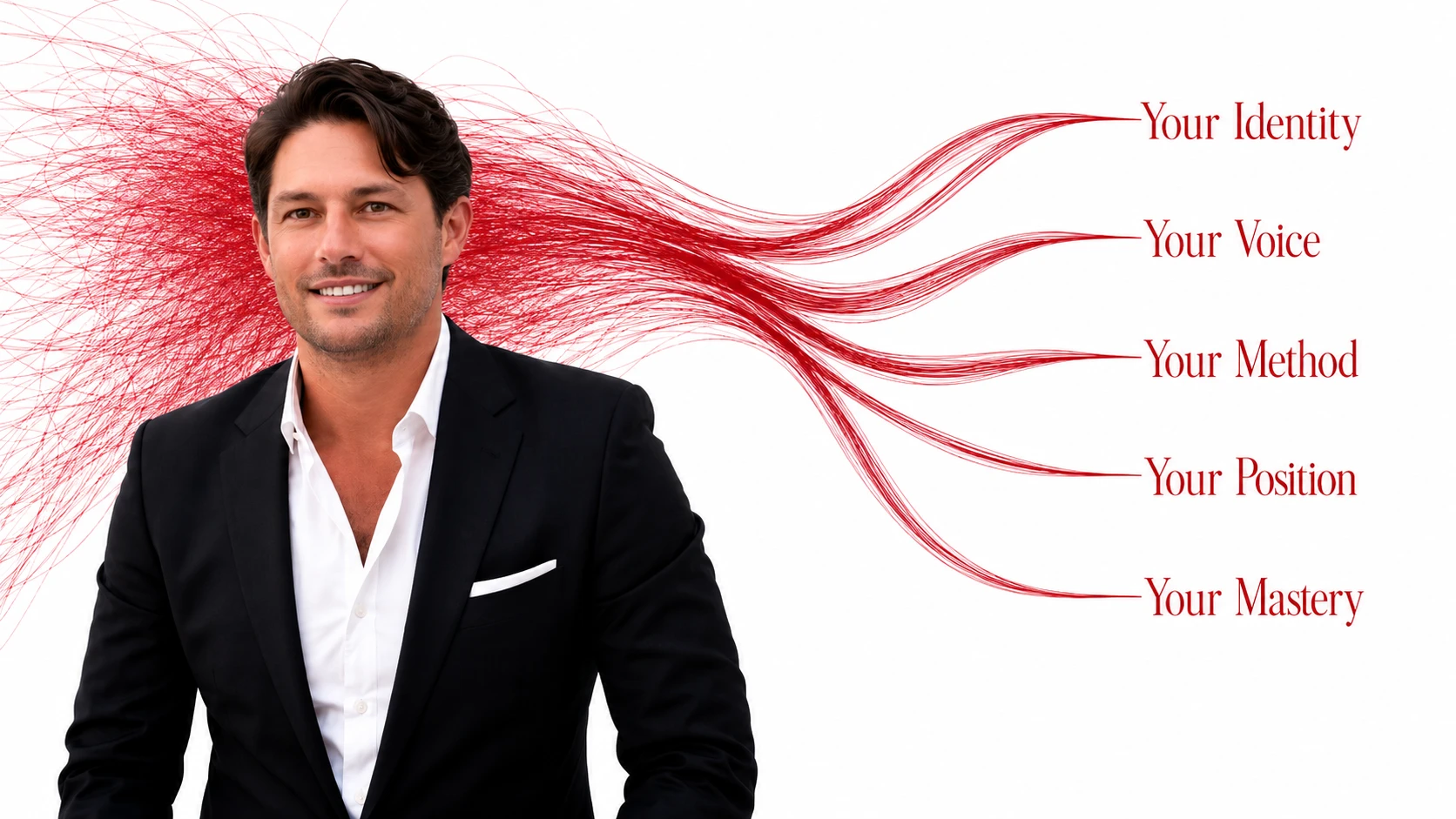
Claude produces the same output for you as for someone who started last year. It doesn't know your voice. Your standards. Your positioning. The expertise you spent a career building. Telling it in a prompt doesn't fix that: prompts disappear, and self-description is the thing people are provably worst at. Old School AI encodes who you actually are into your Claude. Permanently. In five layers. Every conversation starts from who you are.
The Method
Every other tool asks you
to describe yourself. We never do.
Evidence over self-description. Our interview never asks you to describe yourself.
Every question traces to a validated research instrument: the same interview methods the American military developed to learn why its best pilots succeeded, refined across seventy years of published science.
The traditions behind our questions are still bought at the highest level: the change communication discipline 80% of the Fortune 100 pay to apply, the differentiation framework Nintendo's late president credited for the Wii, and the adoption playbook Salesforce and Google hired its author to run.
Rebuilt and grounded in verifiable methodologies, with the same rigor the McKinseys and Boston Consulting Groups of the world apply.
The research is theirs, decades of it. The methodology is ours.
One request, sent twice: “Write a short LinkedIn post announcing that I’m taking on two consulting clients this fall.”
Any Claude
No profile. A template, with the person left as brackets.
This fall, I’m opening my doors to two consulting clients!
After [brief mention of background/experience — e.g., "years of working in X" or "building Y"], I’m ready to bring that expertise directly to a small number of businesses who want hands-on, focused support.
If you’re looking for help with [your specific area — strategy, marketing, operations, etc.], I’d love to chat.
Here’s to a productive fall!
#Consulting #SmallBusiness #NewChapter
Your Claude
The encoded profile. It asks before it drafts, because that preference is in the profile.
Naming the clients — can you name them/industries, or do you want to keep it vague (e.g., "two brands in fashion and wellness")?
Your writing tends to lean into the "why" behind a moment rather than just stating it, so I want to get the frame right.
The ask, if any — is this just sharing news, or is there something you want a reader to do (reach out if they need experiential/brand help, follow along for what’s next, etc.)?
Once I have those three, I’ll draft something short, in your register — grounded, a little wry, no corporate "thrilled to announce" energy.
The Five Layers
Voice is one layer.
We encode five.
Every other tool in this category stops at how you write. That's one layer of who you are.
Your Identity
Personal, free
Your values, your story, and the anchor they build.
Your Voice
Personal, free
Your real writing, read the way psychologists read it. Evidence beats description.
Your Method
Personal, free
Your way of working, turned into rules Claude follows.
Your Position
Personal + Professional
Your audience, your edge. What agencies define for companies, defined for you.
Your Mastery
Personal + Professional
The depth no dataset contains, plus a full library of expert skills built on all five layers.
Your values, your story, and the anchor they build.
Your real writing, read the way psychologists read it.
Your way of working, turned into rules Claude follows.
Your audience, your edge, what makes your work distinct.
The depth no dataset contains.
Five minutes to connect. One chapter a day.
The quality of your answers is the quality of your Claude.
The Quick Start takes about five minutes. Claude becomes an extension of you the same day. Then the journey: five layers, one chapter a day, 15 to 20 minutes each. You encode this once. Every output after that runs through it. Permanently.
Quick Start
Five minutes. Claude connects.
Your Identity
Your Voice
Your Method
Your Position
Your Mastery
One chapter a day
The Two Tiers
Not just who you are.
Who you are, and what you can do.
Personal
Your Claude. Encoded with who you actually are.
The Quick Start, then three chapters: Your Identity, Your Voice, Your Method. Encoded permanently into your Claude, present in every conversation, without you explaining yourself again.
The method, in your hands. You answer, guided by the frameworks built into every question, and your answers never touch an AI system. It's you and the research that built the world's most recognizable brands, applied to you.
On Personal, your answers never leave for any AI system. It's you and the method, full stop.
Free
Always
Included free: Brand Voice, Internal Communications, Copywriting, and AI Platform Migration Coach.
Start for free →Personal + Professional
Your Claude. Extended into every dimension of your professional life.
Everything in Personal, plus two more chapters: Your Position and Your Mastery. Your audience, your positioning, and the earned expertise no dataset contains. The business context Claude can't learn from the tasks you assign it, encoded directly.
And built from your whole profile: a full library of expert skills that updates as your profile evolves.
No need to search for or install additional skills. The repository connects automatically through the connector and keeps growing.
The method, applied with you. We review every answer against the same behavioral-science frameworks and brand research the questions are built on, then give you feedback to sharpen each layer, the review a brand strategist would run, built in, so your identity encodes as precisely as possible.
$99.99
per year
$8.33/month, billed annually
Start your 14-day trial →14 days free. Cancel anytime in the trial. Card required to start.
Old School AI is an independent product. We are not affiliated with, endorsed by, or connected to Anthropic or Claude in any way. Claude is a trademark of Anthropic, PBC.
FAQ
Questions worth asking.
What is Old School AI?
Old School AI is an identity system for Claude. It encodes who you actually are into your Claude permanently: your background, values, communication style, how you operate, and professional expertise. Every output Claude produces for you runs through that context. It stops guessing and starts knowing.
How is this different from just telling Claude about myself?
Two ways.
First, the method. Most people describe the communicator they aspire to be, not the one they actually are. Old School AI's questions are built to extract accurate self-knowledge, not aspirational self-description. The correlation between how people describe their communication style and how they actually communicate is about 0.29 out of 1.0. Our process is designed to close that gap.
Second, the permanence. What you tell Claude in a conversation disappears. What Old School AI encodes into your live profile is account-wide and always-on. Every new conversation starts with Claude already knowing you. The most credible voices in AI engineering call this context engineering: the principle that the quality of AI output is determined not by the prompt, but by the context surrounding it. That’s what your Old School AI profile is. Permanent context.
What is the Old School AI connector, and why does it matter?
Most tools in this category hand you a file and wish you luck. Old School AI is different: one small skill upload plus the Old School AI connector, set up once, and Claude reaches your identity profile live in every conversation.
The connector is what makes your profile a living thing instead of a download. Update an answer tonight and Claude knows it tomorrow. No need to search for or install additional skills: the repository connects automatically through the connector and keeps growing, so every skill on your plan is simply there, in your voice, already knowing who you are.
And it travels with you: installed connectors are active in the Claude mobile app too. Only adding a new custom connector requires desktop.
Do I need a paid Claude plan?
No. The Old School AI connector and the Identity Bridge skill work on every Claude plan, including the free tier. You do need to enable Code Execution in your Claude settings to activate Skills. We walk you through exactly how in your setup guide.
And it travels with you: installed connectors are active in the Claude mobile app too. Only adding a new custom connector requires desktop.
Is Old School AI affiliated with Anthropic or Claude?
No. Old School AI is an independent product. We are not affiliated with, endorsed by, or connected to Anthropic or Claude in any way. We build for Claude because it's the best AI platform for what we do, not because of any relationship with the people who built it.
How does the trial work?
Personal + Professional includes a 14-day free trial. Card required at signup, and you won't be charged until day 15. Cancel anytime during the trial in your account settings and you won't be charged.
If you cancel after the trial, you keep access through the end of your annual term. Your identity profile and everything you encoded stay yours regardless.
Your Claude is waiting to know you.
Every output your Claude produces right now is a best guess. A better-calibrated guess over time, but a guess.
Old School AI changes that. Five minutes to connect. Five layers to complete. Permanent context. Your Claude, finally knowing who it's working with.
Start free. Upgrade to Personal + Professional anytime.
Old School AI is an independent product. Not affiliated with Anthropic or Claude.